“I don’t care if it looks like Poundbury. It’s in the wrong place” Former South Downs National Park Authority member lambasts Eton’s new town plans
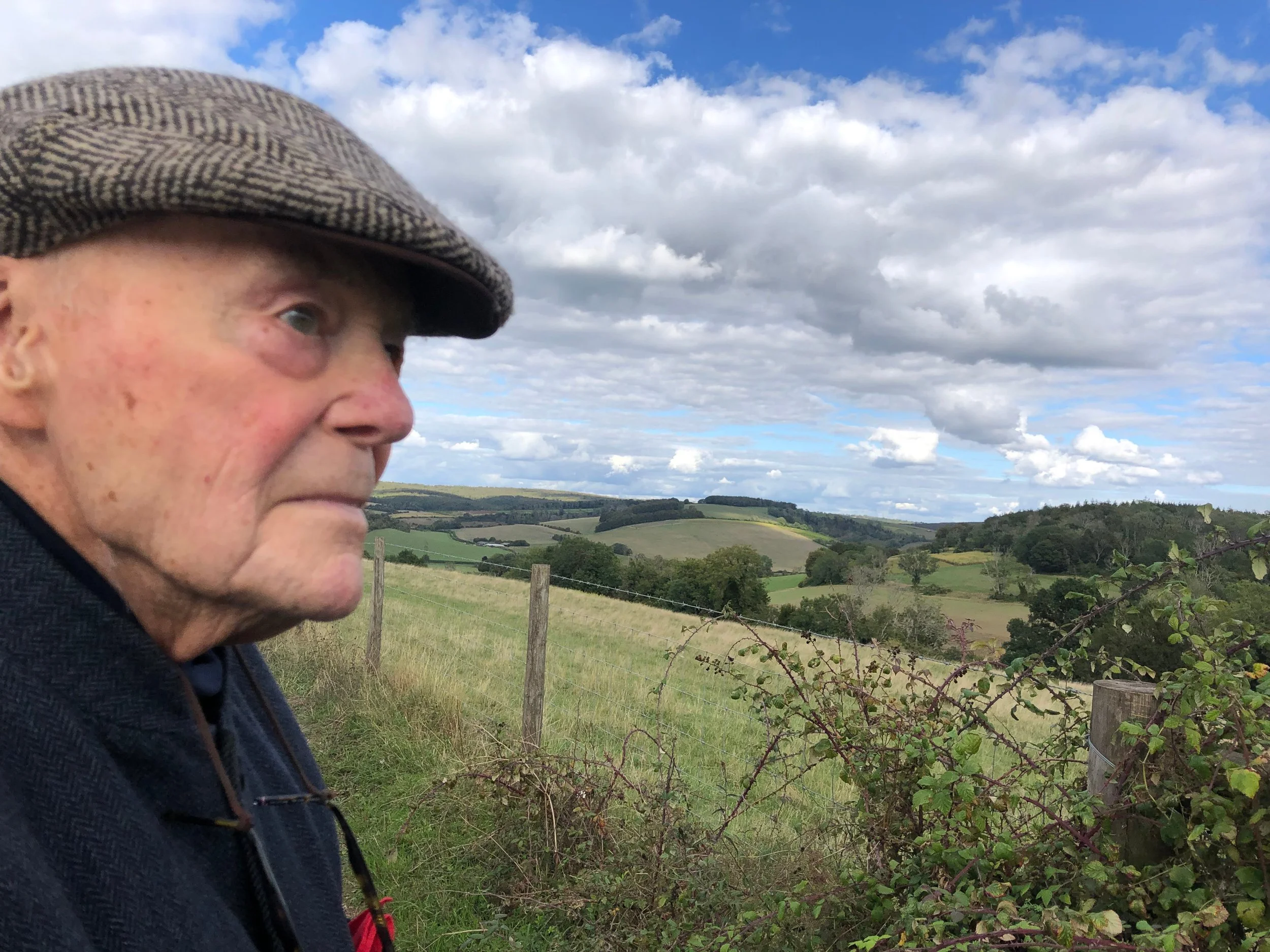
Mark Dunn pictured on South Downs at Goodwood, September 9, 2026
Mark Dunn, a former member of the South Downs National Park Authority in West Sussex, has lambasted Eton College’s plans for a 3,000-house new town at East Chiltington, describing the proposal as “deeply inappropriate” and warning that development on such a scale would damage people’s enjoyment of one of Britain’s most precious landscapes.
Dunn, a former chairman of West Sussex County Council who served on the South Downs National Park Authority from 2008 to 2013, says he would have had no hesitation in opposing the scheme had it come before him as a member.
“This is the wrong place to build a new town,” he said. “If this had come my way, I would certainly have voted against it. It’s an inappropriate development – deeply inappropriate in a very rural bit of farmland.”
Dunn, a former management consultant who was nominated to the National Park Authority by his district council, believes there are far more suitable places to accommodate major housing development in East Sussex.
“If you want to build a new town in East Sussex, there are plenty of places which badly need housing and have lots of undesirable land, especially along the coast,” he said. “I don’t care if it looks like Poundbury. It’s in the wrong place.”
Dunn is particularly concerned about the potential effect of the development on the setting of the South Downs National Park. Although the North Barnes site lies outside the National Park boundary, the Park’s Local Plan makes clear that development beyond its borders can still affect the Park and shouldn’t have a detrimental impact on its setting or prejudice the achievement of National Park purposes.
Policy SD6 of the Local Plan is specifically concerned with safeguarding views - including views to and from viewpoints and recreational destinations, and views experienced from public rights of way, open-access land and other publicly accessible places.
In other words, the landscape seen by someone standing on the South Downs and looking outwards does not suddenly cease to matter because it happens to fall beyond the line marking the National Park boundary.
Dunn says that principle goes to the very heart of what a National Park is for.
“The idea of the National Park is all mixed up with the value of landscape and the value of places where there is little development and you can enjoy nature ‘in the raw’,” he said. “These deeply rural places are very precious and very vulnerable.
“If you’re in the National Park and you look out, your eye shouldn’t be offended.”
For Dunn, protecting those outward views is not simply a matter of aesthetics. It is fundamental to the experience National Parks are intended to provide.
“If anyone makes the effort to walk up a hill to a high point anywhere in the South Downs and looks out over the surrounding landscape, they will be stimulated by the beauty and enriched by the experience,” he said.
“Absolutely essential to the idea of a National Park is the idea that you should be renewed by your contact with nature. If you don’t get the full pleasure of a National Park, that’s a disgrace. It’s part of the Park’s function to give people this experience. They’re nationally important.”
Wildlife, he argues, is inseparable from that experience.
“The wildlife is part of the experience of visiting a National Park. If you’re driving through the National Park and you look out across the landscape and you see a herd of deer, your spirits are lifted.”
There is no statutory fixed distance for the buffer zone surrounding the South Downs National Park but any development immediately outside is still relevant. The Local Plan expressly recognises the importance of the Park’s setting and the potential for development outside its boundary to harm it. This safeguarding of views also specifically encompasses the experience of people using public rights of way, open-access land and other publicly accessible locations.
That distinction could become highly significant if Eton’s proposals progress through the planning system. However, he stressed that the National Park Authority itself is constrained in what it can say about the Eton proposal right now.
He added: “The National Park is in a slightly tricky position. It’s a judicial process, so it has to be independent but it would be a statutory consultee on a development of this size.”
The Authority is also a planning authority in its own right and must be particularly careful not to prejudge a proposal which may ultimately become the subject of a formal planning process.
For Dunn, the fundamental issue is very simple. The countryside at the foot of the South Downs is part of the experience of being in the National Park – and once a deeply rural landscape has been urbanised, that experience cannot simply be recreated elsewhere.
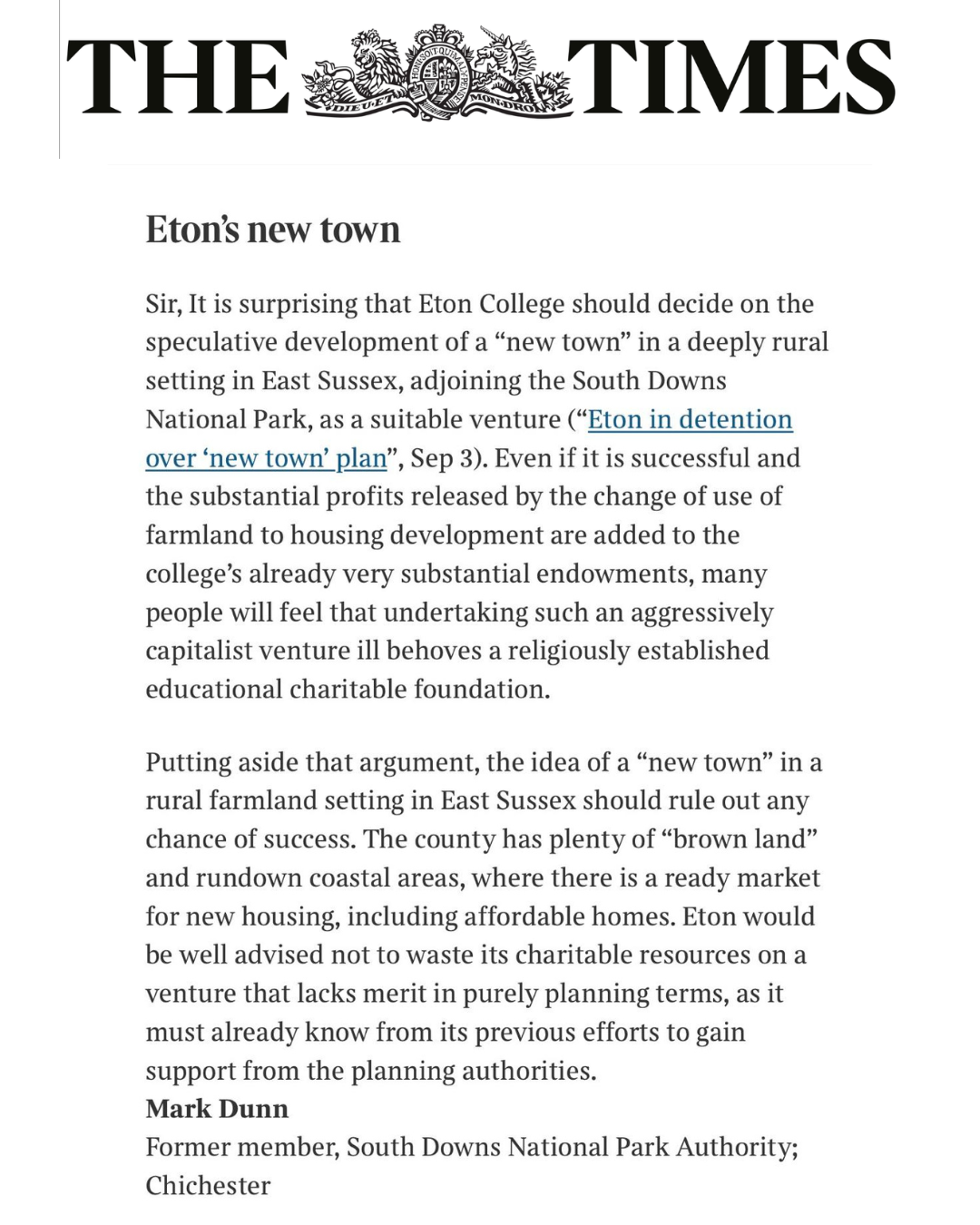
Dunn wrote to the Times on September 4 protesting at Eton’s plans. His letter attracted an extraordinary response - with more than 22,000 views in campaign group Don’t Urbanise the Downs’ Facebook group and more than 1,100 views on Instagram. Don’t Urbanise the Downs spokesperson Steve Needham said: “Clearly Mark’s letter to the Times really struck a nerve with people. The South Downs National Park gets some 500,000 visitors a year and people are rightly appalled at the effect this development would have. Instead of looking down across a beautiful rural landscape from well-known viewpoints like Blackcap, you’ll be looking down on urban sprawl. We strongly believe that the landscape and setting of the South Downs National Park would be utterly destroyed if the scheme goes ahead and Mark makes it very clear that the these are considerations that the South Downs National Park must take into account when it’s eventually consulted as part of the planning process.”